House Of Decks

What’s new

What keeps changing on House Of Decks, newest first. Only what you notice while playing: rules that behave differently, screens that were wrong, and things that were not possible before.

Conquista: Westeros, and regions you can see on the map

There is a twelfth board: Westeros, the Seven Kingdoms from the Wall to Dorne. 43 territories in ten regions - beyond the Wall, the North, the Iron Islands, the Riverlands, the Vale, the Westerlands, the Crownlands, the Reach, the Stormlands and Dorne - and three gates that decide the game, because each of them is a single territory: the Wall, the Neck at Moat Cailin and the Prince's Pass.

It is the only map in the house that is not a real place: the other eleven are cut from a public-domain atlas, while Westeros has its coastline drawn by hand and carved into territories by a generator of its own. It seats up to 6.

And on every board: pointing at a region - in the "Regions and bonuses" list, in the reinforcement chips or at its name on the map - lights the whole of it and dims the rest of the world, so you can see at a glance which territories you have to put together to collect its bonus.

Conquista: the house gets a map, dice and eleven boards

The thirteenth game in the house is not played with a deck of cards: it is played on a map. Conquista is a turn-based territory game for 2 to 6 people, with reinforcements, dice, territory cards and one way to win: being the only player left holding ground.

There are eleven maps and all eleven are playable: Spain (52 territories, all fifty provinces plus Ceuta and Melilla), World (42), North America (30, the United States by state and Canada by province), Europe (25), Asia (24), the Americas (21), Africa (21), the Mediterranean (21, under its ancient names), Oceania (19), Iberia (19, Spain by region) and the Canaries (14, built for tables of two to four). The map is picked before the game starts, and at a public table it is voted on like any other house rule.

You also choose whether the starting armies are scattered for you or placed by hand in rotation, and whether card sets escalate in value with every set handed in at the table or always pay the same.

Before the game starts you also choose who decides the defender’s dice: automatic, which always rolls the maximum and keeps battles running back to back, or as on the board, stopping the game to ask whoever is being attacked.

You can talk during the game: the Diplomacy panel brings the room chat to the table, which is where truces get agreed. As in the classic game a pact binds nobody: the table never stops you attacking anyone.

Every board is drawn with real coastlines: the countries and provinces come from a public-domain atlas, so Alaska is Alaska and Castile and León is the shape it actually is. It is played by touching the map - placing, attacking and regrouping are taps on territories - with zoom and drag for the big board on a phone. The dice are always rolled by the server.

Play from any game page, with nobody to wait for

Playing against the computer has been possible since day one, but the button only lived on the home page and on Quick Play. Anyone arriving from a search for "liar card game rules" landed on that game's page, read how it works, and found a single form for creating a room - meaning they needed to round up other people first. You had to guess the bots were on a different page.

Now all twenty rules pages and all twenty play pages carry their own button, and it deals that game: one click from finishing the rules to playing, with no sign-up and nobody to wait for.

The redrawn deck - court cards, suits, back and joker - ships in this batch too.

A new deck, drawn card by card

The court cards were stick figures: a rectangular torso, a round head with two dots for eyes, and the same face on all twelve cards, recoloured by suit. The knight looked like a giraffe standing on a table. They have all been drawn again from scratch.

The king and the knave of a suit are now two different people - the king bearded and long-haired, the knave young and clean-shaven - each in his own two-colour clothes, and the knight rides a horse with a neck, a croup, hocks and a mane. The faces have brows, eyelids, a nose and lips; the cloth has folds and hatched shading, the way an engraving does.

The suits have been redrawn as the objects they actually are: the coin is minted, with a milled edge; the cup is a chalice with a foot and a knop; the sword has a fuller and quillons; and the club is a branch with the stubs of its cut limbs. On the number cards swords and clubs cross, as they do on a real Spanish deck, and the cups no longer stand upside down on the lower half.

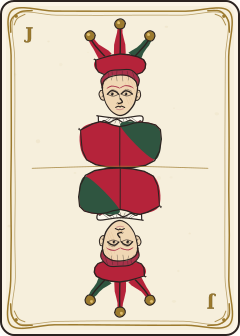
The French deck gets the same treatment: its kings, queens and jacks are double-headed, with a sash and an attribute of their own - the sword, the flower, the halberd. There is a matching new joker too.

All seven card backs from the shop have been redrawn by the same hand, so the backs across the table and the faces in your hand are one deck again: the same wobbled double rule, the same corner flourishes, and in the medallion the same four suits the cards carry. Each back keeps its own colours and its own field pattern, which is what tells them apart - what changed is the drawing, not what you bought.

No line has a constant thickness and no two are quite alike: every card is drawn with its own hand. That is what stops the deck looking like it came out of a machine, which is exactly what it looked like.

More on each game page, and two rules corrected

Every "play" page now explains what the host settles before the deal - that game’s real options, with their values - and what a first game tends to teach you: how long the turn clock is, what the table does when it runs out, and what the interface will not let you do however hard you try.

Checking the text against what the games actually do turned up two things described wrongly. The Continental rules said this version does not allow taking the discard out of turn, and it does: that is the steal, it costs a penalty card, and it is there in every hand. It is now explained, along with the round of offers on the discard, which was not written down anywhere either.

The other one: the El Presi page said cards that are not legal plays appear dimmed. They do not. What stops an invalid play is the play button staying disabled until the selection is right.

The Quick Play pages now cover two things that were not written anywhere: that house rules on a public table are voted for rather than decided by a host, and exactly what happens if you walk out of a public game halfway through.

Continental: undo a set or a run before going down

Forming a combination took the cards out of your hand and sent them up to the table area, looking exactly like the combinations already in play. It read as though you had already thrown them down with no way back, and the button that undid it sat on the other side of the screen.

Now the combinations you are building stay in your own tray, right above your hand, and tapping one sends its cards back to your hand. A line makes it clear they are not on the table yet.

Going down is the part that is final - once per hand - so the table now asks first and shows you exactly which cards are leaving.

Shared links stopped looking bare

This is a game that spreads because somebody passes a room to their friends on WhatsApp or Discord, and until now any link to the site showed up there as a bare line of text.

Every page now has its own preview image: one per game, in both languages, with the house card fan and felt.

The site in English, and considerably faster

The rules, the strategy pages and the site pages were already translated, but the language was a switch inside the page and there was not a single English address. English now lives under /en, with 26 pages of its own, and every page links to its counterpart in the other language.

On performance: the home page is served already drawn rather than assembled in the browser, the fonts come from the site itself, and all the text travels compressed from the origin. On a phone what you notice is how long the first screen takes to appear.

Contrast across all ten themes, and an honest offline page

All ten table themes were gone through one by one looking for text that fell below a legible contrast ratio, the light ones especially. The card fan was fixed too - on narrow screens it hung off both edges.

If you lose your connection the site no longer shows the browser error: a page of its own explains what happened. What it does not do is pretend you can play offline, because the games live on the server.

One click into a game, and the phone layout fixed

Starting a game used to need people: three for Quick Play, two for a private room, and the only way to play against the machine was to create a room and add bots one at a time. There is now a button that sits you at a table with bots directly.

On phones, your hand stopped running off the screen: instead of one row you had to scroll sideways, the cards are spread over several rows and all of them are visible. The small buttons were made big enough to hit with a finger.

El Cuadrado was corrected too: at the start of the round you choose which two cards you look at. It used to show you two fixed ones, which is not how the game is played.

Real rules for every game

Every game now has a full rules page: the deal, the turn, scoring, playing advice and the questions that come up most. They are not "the official rules" - for games like El Presi or Dedo Cagado there are none - but exactly what the table does when you play here, simplifications included where there are any.

The about, contact and privacy pages were added at the same time.

The poker showdown can be read

The last community cards came out and the result appeared over them almost immediately, so there was no time to see what the hand had been won with. The river is now dealt with a deliberate pause, long enough to read the board before the verdict lands.