 House Of Decks
Game rules
Ronda Robada
Build runs to fill your pile, stealing others' piles along the way: once the deck runs out, whoever has the most wins.
Deck
Spanish 40-card deck
Players
2 to 4 players
Card order
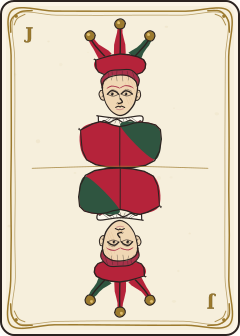
Lowest to highest: Ace, 2, 3, 4, 5, 6, 7, Jack, Queen, King. Exception: after the King, the Ace can be played once more to "close" the run - it's the only card that repeats within the same run.
Dealing
Four loose cards are placed face up in the center of the table and 3 cards are dealt to each player. The rest stays in the deck.
Once everyone is out of cards in hand, if there are still cards left in the deck, 3 more are dealt to each player; this repeats until the deck runs out.
Your pile
Each player has their own pile of won cards beside them. Only the top card (the "visible card") can be seen; the rest sit face down underneath it.
Anyone can use the visible card of any pile - including their own - to continue a run. If it's taken, the whole pile goes with it, not just that card.
How to play
On your turn you play a card from your hand. If its rank matches a loose card on the table, you combine them to start your run. You can't start one directly against a pile's visible card, only with a loose card.
From there, you decide how to continue: you can tap, one at a time, the next cards in the sequence - a loose card of that rank, or if there isn't one, the visible card of someone's pile (including your own), taking that whole pile with it. At each step you see your run grow before deciding the next one.
You can stop and confirm your run at any time, even if there were still cards to continue with. When you confirm, everything you've gathered - your starting card, the loose cards, and any piles you picked up along the way - moves to your pile all at once, with your starting card ending up visible on top.
If you can't or don't want to play
You can drop any card from your hand as another loose card on the table, for you or others to use later. You can only drop a card if you haven't started building a run yet this turn.
End of the game and scoring
Once the deck runs out and the last cards are played, the game ends. Any loose cards left on the table go to whoever made the last run.
Your score is the sum of each card's rank in your pile (Ace = 1, ..., Jack = 10, Queen = 11, King = 12). Whoever scores the most wins.
Tips and strategy
When to stop your run
You can confirm a run at any point, even with more cards available. Stopping early is sometimes right: every card you leave on the table is a loose card somebody else can start their own run with.
Conversely, climbing further only pays if you collect piles along the way. Extending a run with loose cards gains you little; taking somebody’s pile gains you everything stacked underneath it.
Protecting your pile
Only the top card of your pile is visible, and anyone can steal the whole thing by using it in their run. The card you leave showing is, in practice, the door to your pile.
If your pile is already big, avoid leaving a card showing that fits the sequences other people are building. Sometimes it is worth making a short run purely to change which card is on top.
The Ace closes after the King. A long run ending on an Ace is the hardest to interrupt, because almost nobody is still holding an Ace by then.
Frequently asked questions
Can I start a run against somebody’s pile?
No. A run only starts by matching a card from your hand to a loose card on the table of the same rank. Piles can only be used to continue a run that is already going.
What happens when I take somebody’s pile?
You take all of it, not just the visible card: everything stacked underneath moves to your pile. It is the biggest points swing in the game.
How is scoring worked out?
Add up the value of every card in your pile: Ace = 1, 2 through 7 = face value, Jack = 10, Knight = 11, King = 12. Highest total wins, and any loose cards left on the table at the end go to whoever made the last run.
What do I do if I cannot play anything?
Drop any card from your hand onto the table as a new loose card. You can only do this if you have not already started building a run that turn.
Ronda Robada, against the computer
Deal right now against the computer - no sign-up, nobody to wait for.
Play now against the computer